The most common melatonin side effects are daytime sleepiness, headache, dizziness and nausea, and in short-term studies they are usually mild and pass within a few days. What is far less certain is the long-term picture: no large trials have followed regular users for years, and the amount of melatonin in a supplement can differ widely from the label.
Melatonin is a hormone your brain makes in the evening to signal that it is night. Synthetic melatonin is sold as a sleep aid, and its use has grown quickly: in US national survey data, the share of adults taking it rose from 0.4% in 1999–2000 to 2.1% in 2017–2018, according to a 2022 JAMA research letter. This guide sets out what the trials, regulators and poison-centre data say about its side effects, who should be more careful, and what the recent heart failure headlines do and don't show.
Common melatonin side effects
The largest pooled look at safety is a 2019 systematic review in CNS Drugs of 37 randomised controlled trials, using doses from 0.15 mg to 12 mg a day. After subtracting the rates seen with placebo, the most frequently reported side effects were:
| Side effect | Extra people affected vs placebo |
|---|
| Daytime sleepiness | 1.66% |
| Headache | 0.74% |
| Other sleep-related effects | 0.74% |
| Dizziness | 0.74% |
| Feeling cold (hypothermia) | 0.62% |
Source: Besag et al. 2019, CNS Drugs (placebo-corrected rates).
The reviewers found no side effects that were life threatening or of major clinical significance, and said the large majority resolved on their own within a few days or after stopping. Side-effect rates were "not obviously correlated with either dose or formulation".
The US National Center for Complementary and Integrative Health (NCCIH) lists a similar set from short-term studies: headache, dizziness, nausea and sleepiness, and notes a possible risk of allergic reactions. Australia's healthdirect adds that mood swings can occur in rare cases.
What the UK prescribing label lists
In the UK, melatonin is a prescription medicine. The licensed product, Circadin 2 mg prolonged-release tablets, has an official Summary of Product Characteristics that lists side effects by frequency. It lists none as very common or common. Effects classed as uncommon (between 1 in 1,000 and 1 in 100 people) include:
- irritability, restlessness, anxiety, abnormal dreams and nightmares
- headache, migraine, dizziness, lethargy and sleepiness
- abdominal pain, indigestion, dry mouth, mouth ulcers and nausea
- high blood pressure, night sweats, itching, rash and weight gain
Rare effects (between 1 in 10,000 and 1 in 1,000) include low mood or depression, aggression, palpitations, blurred vision, memory problems and restless legs. Allergic reactions, including swelling of the mouth or tongue (angioedema), are listed with unknown frequency.
The label also gives an honest comparison: in clinical trials, 48.8% of people taking Circadin reported an adverse reaction, compared with 37.8% taking placebo. In other words, many reported "side effects" also happen on a dummy pill.
Long-term melatonin side effects: what we know
This is the biggest gap. Most trials in the 2019 review lasted four weeks or less, and the authors concluded that "the scarcity of evidence from long-term RCTs" limits conclusions about continuous use over long periods. NCCIH says the same: "The possible long-term side effects of melatonin use are unclear."
Some longer data exist. The UK label notes that 5 mg a day was given for 12 months in trials, but the licence itself covers short-term use only, for up to 13 weeks. For children, NCCIH notes that melatonin could in theory affect puberty, menstrual cycles and the hormone prolactin, "but we don't know for sure."
Does melatonin cause heart failure?
In November 2025, a study presented at the American Heart Association's Scientific Sessions attracted wide coverage. Using electronic health records from 130,828 adults with chronic insomnia, researchers compared people with at least a year of recorded melatonin use with matched non-users. Over five years, heart failure was diagnosed in 4.6% of melatonin users vs 2.7% of non-users, and deaths from any cause were 7.8% vs 4.3% (Circulation abstract 4371606).
These figures need care. This was an observational study, and the AHA's own release stated that the findings "do not prove that melatonin itself caused the increased risks." A 2026 peer-reviewed review described it as "a single, as-yet unpublished conference abstract that has not undergone peer review or independent validation". Important limitations include:
- Confounding by indication: insomnia itself is a risk factor for heart disease, and people prescribed melatonin may have had worse sleep or more health problems (see confounding).
- Misclassification: in the US, most people buy melatonin over the counter, so many "non-users" may actually have taken it.
- Missing data: there was no information on insomnia severity or mental health conditions.
The result is a signal worth investigating with proper trials, not proof of harm. The 2026 review called for prospective studies at typical supplement doses of 3 mg to 10 mg or higher.
Too much melatonin: overdose and children
Very large doses appear to be tolerated by adults in the short term: the UK label notes reports of up to 300 mg a day without clinically significant reactions. Children are a different story, largely because of accidental ingestion at home.
A CDC MMWR report found that US poison centres received 260,435 reports of melatonin ingestion in children and teenagers between 2012 and 2021. Annual reports rose 530%, from 8,337 to 52,563. Most children had no symptoms and 94.3% of ingestions were unintentional, but 4,097 were hospitalised, 287 needed intensive care, five needed a ventilator and two children under 2 died. Healthdirect advises that melatonin should not be given to children under 2.
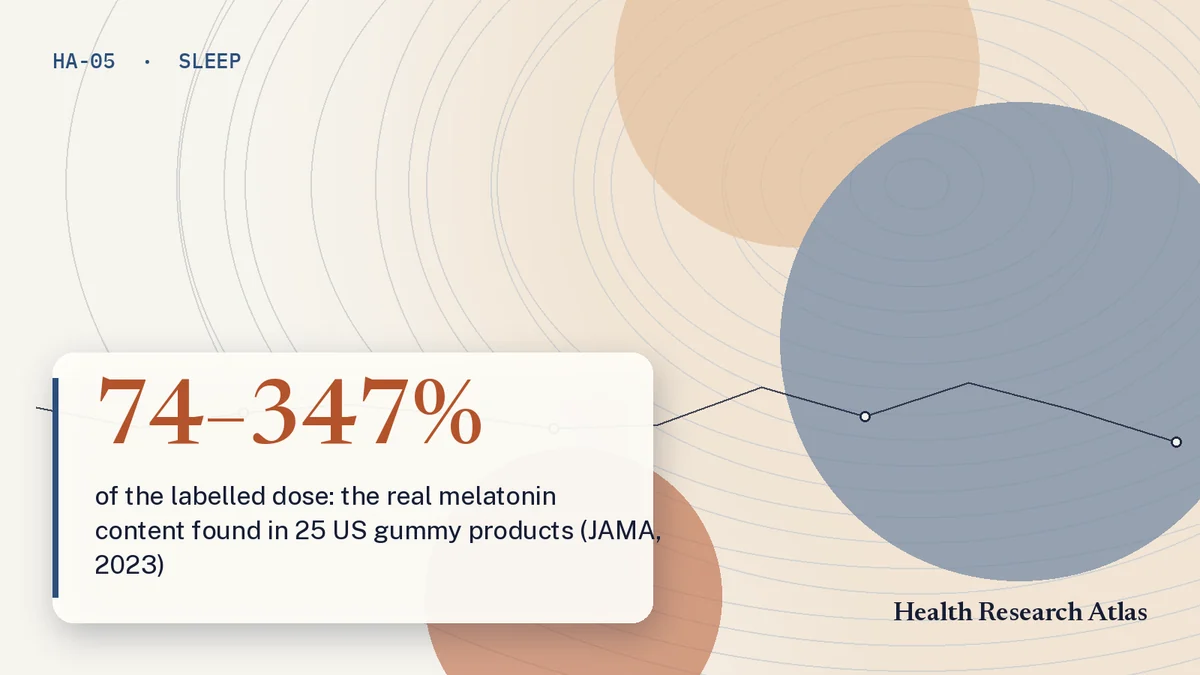
Label accuracy adds to the risk. A 2023 JAMA analysis of 25 melatonin gummy products sold in the US found the actual melatonin content ranged from 74% to 347% of the labelled amount; 22 of the 25 (88%) were inaccurately labelled, and five also contained CBD. NCCIH reports that an earlier study found serotonin in 26% of the supplements tested.
Melatonin side effects in elderly people
Older adults are the group for whom melatonin is licensed in the UK (age 55 and over) and sold without prescription in Australia (slow-release form, over 55s only). But NCCIH warns that melatonin "may stay active in older people longer than in younger people and cause daytime drowsiness", which matters for falls and driving. The UK label says Circadin has a "moderate influence" on the ability to drive, and healthdirect advises against taking it before driving or using machinery.
For people with dementia, NCCIH notes that the American Academy of Sleep Medicine's 2015 guideline recommends against melatonin use.
Interactions and who should be careful
Melatonin is broken down mainly by liver enzymes in the CYP1A family, so medicines that affect this enzyme change how much reaches the blood. The UK label lists the key interactions:
| Medicine or substance | Effect |
|---|
| Fluvoxamine (an antidepressant) | 17-fold higher melatonin exposure; combination should be avoided |
| Quinolone antibiotics, cimetidine | May increase melatonin levels |
| Carbamazepine, rifampicin, smoking | May reduce melatonin levels |
| Oestrogens (contraceptive pill, HRT) | Use with caution |
| Benzodiazepines, zolpidem, zopiclone | Sedation may be increased |
| Alcohol | Reduces melatonin's effect on sleep; avoid |
NCCIH adds that people with epilepsy and those taking blood thinners need medical supervision if they use melatonin. The UK label does not recommend it for people with autoimmune diseases (because there are no data) or liver impairment.
Pregnancy and breastfeeding: research is lacking. The UK label does not recommend melatonin in pregnancy, when trying to conceive, or while breastfeeding, and healthdirect advises against use in pregnancy.
Does melatonin work for insomnia?
Side effects only make sense weighed against benefit. The American Academy of Sleep Medicine guideline on medicines for chronic insomnia suggests that clinicians not use melatonin for trouble falling or staying asleep in adults. This is a weak recommendation based on very low-quality evidence from trials of 2 mg doses. In one trial it cited, melatonin shortened the time to fall asleep by 8.9 minutes, which the authors judged below clinical significance. The guideline panel judged benefits to be "approximately equal to harms". NCCIH discusses jet lag, delayed sleep-wake phase disorder and anxiety before surgery as areas where melatonin has been studied, and says the evidence for insomnia is not strong enough to recommend it. For chronic insomnia, a 2026 AASM guideline describes cognitive behavioural therapy for insomnia (CBT-I) as the most effective first-line treatment. See more on our sleep topic page.
How rules differ by country
- US: sold as a dietary supplement, which the FDA regulates less strictly than a medicine.
- UK: prescription only; Circadin is licensed for people aged 55 and over at 2 mg, 1 to 2 hours before bed, for up to 13 weeks.
- Australia: people over 55 can buy slow-release melatonin over the counter; everyone else needs a prescription.
When to see a doctor
Get urgent help (call 911, 999 or 000, or poison control on 1-800-222-1222 in the US) if a child swallows melatonin and is very drowsy, hard to wake or has trouble breathing, or if anyone has swelling of the face, lips or tongue or difficulty breathing after taking it.
Talk to a doctor or pharmacist before using melatonin if you are pregnant or breastfeeding, have epilepsy, an autoimmune or liver condition, or take blood thinners, fluvoxamine, sedatives or hormones. Also see a doctor if you need a sleep aid for more than a few weeks, feel low or sleepy during the day, or snore loudly or stop breathing at night, as these can point to a sleep disorder that needs proper treatment.
How strong is the evidence?
We grade this article moderate. Short-term safety is supported by a systematic review of 37 randomised trials and by regulatory data, which consistently show mild, uncommon side effects. Evidence on long-term safety is weak: trials were mostly short, and the heart failure finding comes from a single observational conference abstract. Children's ingestion figures come from national poison-centre data, which count reports, not confirmed harms.
What we still don't know
We don't know whether nightly melatonin over years affects the heart, hormones or puberty, what dose is safest, or how much of the risk in observational studies is due to poor sleep itself. Better-regulated products and long-term randomised trials would help answer these questions.
Frequently asked questions
What are the most common side effects of melatonin?
The most common are daytime sleepiness, headache, dizziness and nausea. In trials they were usually mild and resolved within a few days or after stopping.
Is it safe to take melatonin every night long term?
Nobody knows for sure. Most trials lasted 4 weeks or less, NCCIH says long-term side effects are unclear, and the UK licence covers only up to 13 weeks, so talk to a doctor if you need it for longer.
Does melatonin cause heart failure?
That has not been shown. A 2025 conference abstract found more heart failure in long-term users with insomnia, but it was observational and not peer reviewed, and insomnia itself raises heart risk.
What happens if you take too much melatonin?
Adults mostly get more drowsiness, headache or dizziness. Children who swallow it accidentally usually have no symptoms, but US poison-centre data recorded thousands of hospital stays, so call poison control if a child takes some.
Is melatonin safe for elderly people?
It is licensed in the UK for people aged 55 and over for short-term use, but it may stay active longer in older people and cause daytime drowsiness, which can affect driving and falls. Guidance advises against it in dementia.
Sources
- Sateia MJ, Buysse DJ, Krystal AD, Neubauer DN, Heald JL. Clinical Practice Guideline for the Pharmacologic Treatment of Chronic Insomnia in Adults: An American Academy of Sleep Medicine Clinical Practice Guideline. J Clin Sleep Med. 2017;13(2):307-349. doi:10.5664/jcsm.6470
- National Center for Complementary and Integrative Health. Melatonin: What You Need To Know. Last updated May 2024. nccih.nih.gov
- Healthdirect Australia. Melatonin. Last reviewed June 2025. healthdirect.gov.au
- Circadin 2 mg Prolonged-release Tablets: Summary of Product Characteristics. RAD Neurim Pharmaceuticals. Electronic Medicines Compendium. medicines.org.uk
- Besag FMC, Vasey MJ, Lao KSJ, Wong ICK. Adverse Events Associated with Melatonin for the Treatment of Primary or Secondary Sleep Disorders: A Systematic Review. CNS Drugs. 2019;33:1167-1186. doi:10.1007/s40263-019-00680-w
- Cohen PA, Avula B, Wang YH, Katragunta K, Khan I. Quantity of Melatonin and CBD in Melatonin Gummies Sold in the US. JAMA. 2023;329(16):1401-1402. doi:10.1001/jama.2023.2296
- Lelak K, Vohra V, Neuman MI, Toce MS, Sethuraman U. Pediatric Melatonin Ingestions: United States, 2012–2021. MMWR Morb Mortal Wkly Rep. 2022;71(22):725-729. doi:10.15585/mmwr.mm7122a1
- Li J, Somers VK, Xu H, Lopez-Jimenez F, Covassin N. Trends in Use of Melatonin Supplements Among US Adults, 1999-2018. JAMA. 2022;327(5):483-485. doi:10.1001/jama.2021.23652
- Nnadi E, et al. Abstract 4371606: Effect of Long-term Melatonin Supplementation on Incidence of Heart Failure in Patients with Insomnia. Circulation. 2025;152(Suppl 3). Conference abstract. doi:10.1161/circ.152.suppl_3.4371606
- Savvidis C, Thomopoulos C, Ilias I. Melatonin supplementation, hyperprolactinemia, and incident heart failure: A proposed prolactin-mediated pathway for cardiovascular risk. World J Exp Med. 2026;16(2):120754. doi:10.5493/wjem.v16.i2.120754
- Buysse DJ, Arnedt JT, Buenaver L, et al. Combination treatment for chronic insomnia disorder in adults: an American Academy of Sleep Medicine clinical practice guideline. J Clin Sleep Med. 2026. doi:10.1007/s44470-025-00038-8
This article is for general information and isn't a substitute for advice from your doctor or another qualified health professional. See our medical disclaimer and editorial standards. Spotted an error? Tell us.