Interoception is the sense of what is happening inside your own body: the way your nervous system picks up, interprets and combines signals such as your heartbeat, breathing, hunger, fullness and the need to use the toilet. Researchers increasingly see differences in interoception as part of several mental health conditions, including anxiety, depression, eating disorders and addiction, but the evidence is more mixed than many popular accounts suggest.
This guide is based on the 2018 expert roadmap Interoception and Mental Health, the US National Institutes of Health (NIH) interoception initiative, and recent systematic reviews and meta-analyses on anxiety, autism and treatment. It explains what interoception is, how scientists measure it, what the research does and does not show, and when body sensations are worth checking with a doctor.
Interoception definition: what is interoception?
The most widely cited definition comes from a group of experts who met at the first Interoception Summit, organised by the Laureate Institute for Brain Research in November 2016. They define interoception as "the process by which the nervous system senses, interprets, and integrates signals originating from within the body".
The NIH uses a slightly broader version. Its research initiative aims to understand how organisms "sense, interpret, integrate, and regulate internal bodily signals". The word "regulate" matters: interoception is not only about noticing signals, but also about the brain using them to keep the body in balance, for example adjusting breathing or heart rate.
A key point is that most of this work happens without you noticing. The 2018 roadmap stresses that "most interoceptive processes occur outside the realm of conscious awareness". What people usually mean by "good" or "poor" interoception is the small, conscious part: how well they notice and make sense of body signals.
Which body signals count?
Interoception covers communication from many body systems to the brain. The NIH's complementary and integrative health centre (NCCIH) highlights brain links with the heart and blood vessels, the hormone (endocrine) and immune systems, the breathing system, and the vagal and spinal nerve pathways that connect organs to the brain.
In everyday terms, that includes signals people describe as:
- a racing or pounding heart
- breathlessness or the urge to take a deep breath
- hunger, fullness and thirst
- a full bladder or bowel
- stomach churning or "butterflies"
- feeling hot, cold, tense or tired
The different dimensions of interoception
Interoception is not one skill. The expert roadmap says it "is not a simple process but rather has several facets", and adds that "there is no generally agreed-on taxonomy" yet. A landmark 2015 study of 80 adults by Garfinkel and colleagues showed that three commonly measured dimensions are "distinct and dissociable": being good at one does not mean being good at the others.
| Dimension | What it means | How it is usually measured |
|---|
| Interoceptive accuracy | How correctly you detect a body signal | Heartbeat tasks (counting or timing heartbeats without touching your pulse) |
| Interoceptive sensibility | How much attention you believe you pay to body signals, and how you rate yourself | Questionnaires and interviews |
| Interoceptive awareness (insight) | Whether your confidence matches your actual accuracy | Comparing confidence ratings with task performance |
| Other facets | Attention, detection, perceived intensity, and telling one sensation apart from another | Varies; often research-only tasks |
The difference matters because headlines often say a group "has poor interoception" when a study measured only one of these dimensions, usually self-report or a heartbeat task.
How the brain processes interoception
Signals from the organs reach the brain through nerves (including the vagus nerve and spinal pathways) and through chemical messengers such as hormones and immune signals. The roadmap identifies the insula and somatosensory cortices as key regions for receiving these signals, and describes a wider network that tracks changes in body state, including "the insula, somatosensory cortices, cingulate, amygdala, thalamus, and brainstem". Regions such as the anterior insula and anterior cingulate are also involved in sending signals back to the body. The authors note that how far these represent separate or overlapping systems "is currently unclear".
Interoception and anxiety
Anxiety is the condition most often linked to interoception, because many anxiety symptoms are body sensations, such as a racing heart in panic. The results, however, depend heavily on how interoception is measured.
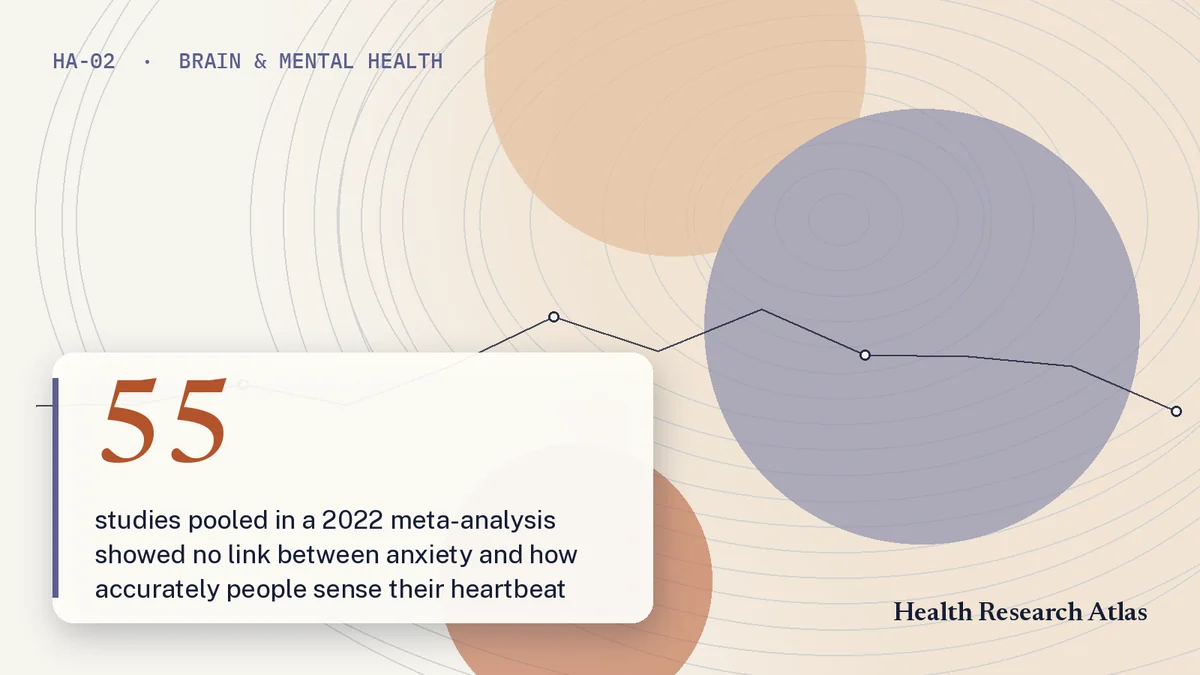
- Accuracy tests: a 2022 meta-analysis of 55 studies by Adams and colleagues "found no evidence for an association between cardiac interoceptive accuracy and anxiety". People with anxiety were, on average, no better or worse at detecting their heartbeat.
- Self-report: a 2024 meta-analysis of 71 studies using questionnaires found that anxiety was associated with "increased negative evaluations of, frequency of, and sensitivity to, bodily signals". In other words, anxious people tend to notice body signals more and judge them as more threatening, even if their objective detection is not different.
That pattern, more worry about body signals rather than better or worse detection, is a useful way to think about the link. The two meta-analyses measure different things, so they do not contradict each other.
Interoception and autism
The 2018 roadmap lists autism among conditions with signs of interoceptive differences, giving skin hypersensitivity as an example. The research picture is still unsettled.
A 2025 systematic review and meta-analysis in Frontiers in Psychiatry included 31 studies. It concluded that autism "is not systematically associated with altered" cardiac interoceptive accuracy; a pooled analysis of 5 adult studies found no statistically significant difference (p = .06). The authors say the relationship between autism and other dimensions, such as self-reported interoception, remains unclear. The authors say "methodological diversity, differences in measurement instruments, and variability in sample characteristics" likely explain the inconsistencies, and call for more standardised methods.
So while individual autistic people may have real and important interoceptive differences, research does not yet show a single, consistent pattern across the autistic population.
Other conditions linked to interoception
The 2018 roadmap names "anxiety disorders, mood disorders, eating disorders, addictive disorders, and somatic symptom disorders" as conditions where interoceptive dysfunction is increasingly recognised, and also discusses panic disorder, post-traumatic stress disorder (PTSD), depersonalisation and autism. In eating disorders, for example, it lists "hunger insensitivity, food anxiety, gastrointestinal complaints" as relevant signs.
The NIH goes further, stating that impaired interoceptive function "underlies conditions such as obesity, diabetes, anxiety, depression", and its list continues with substance use disorders, Alzheimer's, Parkinson's, autism, chronic pain, PTSD, irritable bowel syndrome (IBS), fibromyalgia and heart disease. This is a statement of research priorities: for most of these conditions, studies show associations rather than proof that interoception problems cause the illness.
Interoception and ADHD: people often search for this link, but none of the reviews we used for this article examined ADHD, so we cannot summarise reliable evidence on it here.
Why measuring interoception is hard
The most common lab test, the heartbeat counting task, asks people to count their heartbeats over short periods without feeling their pulse. A 2022 meta-analysis of 133 studies and 11,524 adults by Desmedt and colleagues found that scores on this task were not linked with trait anxiety, depression or alexithymia (difficulty identifying emotions), contrary to what theory predicted. Scores were weakly related to age, sex, heart rate and body mass index. The authors also found that very few studies were pre-registered (0.8%) or justified their sample size (6%).
Questionnaires have their own problems: they measure what people believe about their body awareness, which can overlap with anxiety itself. The roadmap's authors call for "the reliability and validity of methods" to be "rigorously established".
Can interoception be improved?
Several therapies aim to change how people notice and interpret body signals. A 2023 systematic review of 31 randomised controlled trials by Heim, Fotopoulou and colleagues looked at these "interoception-based interventions" in mental health and related conditions, including chronic pain, PTSD, IBS, fibromyalgia, substance use and eating disorders. The approaches included mindfulness-based programmes (such as MBCT and MBSR), body-awareness therapies, cognitive behavioural therapy with interoceptive exposure, and floatation therapy.
| Outcome | What the 31 trials found |
|---|
| Interoception (mostly self-reported) | 20 trials (64.5%) favoured the intervention over control |
| Symptoms | 15 trials favoured the intervention; the authors judged the evidence "inconclusive" |
| Most promising areas | PTSD, IBS, fibromyalgia and substance use disorders |
The review rated study quality "moderate to good" but warned that "almost all studies investigated interoception only by self-report". In short, these approaches often change how people rate their body awareness, but it is less clear that this reliably reduces symptoms.
When to see a doctor: body sensations should not be put down to "interoception" without a check-up. Seek urgent help for chest pain, severe breathlessness, fainting, a very fast or irregular heartbeat that does not settle, or sudden weakness. See a GP or primary care doctor if you have frequent palpitations, panic attacks, changes in appetite or weight, or body symptoms that worry you or affect daily life. If anxiety, low mood, eating difficulties or substance use are affecting you, a doctor can refer you for assessment and evidence-based psychological treatment.
How strong is the evidence?
We grade this topic as emerging (see how we grade evidence). The definition and the idea that interoception has several dimensions are well established in expert consensus and repeated studies. Links with mental health are supported by large meta-analyses, but those show that results depend on the measurement method: questionnaire-based links with anxiety are consistent, while objective heartbeat tasks show little or no association. Trials of interoception-based therapies are numerous but small and varied, and mostly rely on self-report. For more on why expectations and self-report can shape study results, see our guide to the placebo effect, and explore more articles in brain and mental health.
What we still don't know
- Whether interoceptive differences cause mental health conditions, result from them, or simply occur alongside them.
- Which test best measures interoception, and whether heartbeat tasks reflect interoception at all or are shaped by beliefs about heart rate.
- Whether improving interoception leads to lasting symptom relief, and for whom.
- How interoception relates to ADHD and other conditions with little high-quality research so far.
The NIH has made interoception a major research priority, with a second phase of its initiative covering the fiscal years 2026 to 2030, so answers to some of these questions may come in the next few years.
Frequently asked questions
What is interoception in simple terms?
Interoception is your sense of what is happening inside your body. It is how your nervous system picks up and makes sense of signals such as your heartbeat, breathing and hunger.
What are examples of interoception?
Noticing that your heart is racing, feeling hungry or full, sensing that you need to take a deep breath and feeling the urge to use the toilet are all examples. Most interoceptive processing happens without conscious awareness.
Is interoception linked to anxiety?
Partly. Meta-analyses find that anxious people do not detect their heartbeat more or less accurately, but they report noticing body signals more and judging them more negatively.
Do autistic people have poor interoception?
Not consistently. A 2025 systematic review of 31 studies found autism is not systematically linked with altered heartbeat accuracy, and results for other dimensions were unclear, although individuals may differ.
Can you improve interoception?
Mindfulness-based and body-awareness therapies often improve self-rated interoception in trials. Whether this reliably reduces symptoms is less certain: a review of 31 trials judged that evidence inconclusive.
Sources
- Khalsa SS, Adolphs R, Cameron OG, et al. Interoception and Mental Health: A Roadmap. Biol Psychiatry Cogn Neurosci Neuroimaging. 2018;3(6):501-513. doi:10.1016/j.bpsc.2017.12.004
- National Institutes of Health. NIH Blueprint for Neuroscience Research Initiative on Interoception. Last reviewed June 2026. nih.gov
- National Center for Complementary and Integrative Health. Interoception Research (Strategic Plan FY 2021-2025). nccih.nih.gov
- Garfinkel SN, Seth AK, Barrett AB, Suzuki K, Critchley HD. Knowing your own heart: distinguishing interoceptive accuracy from interoceptive awareness. Biol Psychol. 2015;104:65-74. PubMed 25451381
- Adams KL, Edwards A, Peart C, et al. The association between anxiety and cardiac interoceptive accuracy: a systematic review and meta-analysis. Neurosci Biobehav Rev. 2022;140:104754. doi:10.1016/j.neubiorev.2022.104754
- The relationship between self-reported interoception and anxiety: a systematic review and meta-analysis. Neurosci Biobehav Rev. 2024;167:105923. doi:10.1016/j.neubiorev.2024.105923
- Desmedt O, Van Den Houte M, Walentynowicz M, et al. How does Heartbeat Counting Task performance relate to theoretically-relevant mental health outcomes? A meta-analysis. Collabra: Psychology. 2022;8(1):33271. doi:10.1525/collabra.33271
- Klein M, Witthöft M, Jungmann SM. Interoception in individuals with autism spectrum disorder: a systematic literature review and meta-analysis. Front Psychiatry. 2025;16:1573263. doi:10.3389/fpsyt.2025.1573263
- Heim N, Bobou M, Tanzer M, Jenkinson PM, Steinert C, Fotopoulou A. Psychological interventions for interoception in mental health disorders: a systematic review of randomized-controlled trials. Psychiatry Clin Neurosci. 2023;77:530-540. doi:10.1111/pcn.13576
This article is for general information and isn't a substitute for advice from your doctor or another qualified health professional. See our medical disclaimer and editorial standards. Spotted an error? Tell us.