The best-supported fatty liver diet is not a branded plan: it is a Mediterranean-style way of eating that cuts sugary drinks, ultra-processed food and alcohol, combined with enough of a calorie deficit to lose weight if you are overweight. Losing about 5% of body weight reduces liver fat, and losing 10% or more gives the best chance of reversing inflammation and scarring.
That is the shared message of the two main specialist guidelines: the 2024 European guideline from EASL, EASD and EASO and the 2023 American Association for the Study of Liver Diseases (AASLD) practice guidance. Below we set out what they recommend, the trials behind it, a practical food list, and the points where the US and European advice differ.
What is fatty liver disease, and why diet matters
Fatty liver disease means too much fat (triglyceride) is stored in the liver. The condition most people mean by "fatty liver" now has a new name. According to the European guideline, "MASLD replaces the old term non-alcoholic fatty liver disease (NAFLD)". MASLD stands for metabolic dysfunction-associated steatotic liver disease, and it is defined as excess liver fat plus at least one cardiometabolic risk factor: overweight or a large waist, raised blood sugar or type 2 diabetes, raised triglycerides, low HDL cholesterol, or blood pressure of 130/85 mmHg or above (or treatment for it). The inflamed form, once called NASH, is now called MASH.
It is very common. The European guideline estimates that global prevalence has risen from 25% in 2016 to "currently more than 30%". The US guidance gives a similar figure of 25% to 30% of adults in the general population (both are prevalence estimates, not counts of diagnosed cases).
Diet matters because the main drivers are metabolic. The AASLD guidance notes that dietary sugars "drive the formation and accumulation of intrahepatic fat", and that "Excessive fructose consumption in particular increases the risk of NAFLD, NASH, and advanced fibrosis", independent of calorie intake. Both guidelines put lifestyle change (diet, activity and alcohol) first. Medicines such as GLP-1 receptor agonists are a separate question and are not covered here.
How much weight loss helps the liver
If you are overweight, the amount of weight you lose is the single strongest predictor of how much your liver improves. The AASLD guidance puts it simply: "Weight loss improves hepatic steatosis, NASH, and hepatic fibrosis in a dose-dependent manner." The two guidelines set slightly different targets:
| Goal | European guideline (EASL-EASD-EASO 2024) | US guidance (AASLD 2023) |
|---|
| Reduce liver fat | At least 5% of body weight, sustained | 3% to 5% improves steatosis |
| Reduce inflammation (MASH) | 7% to 10% | More than 10% generally required |
| Improve scarring (fibrosis) | At least 10% | More than 10% generally required |
For someone weighing 90 kg (about 198 lb), 5% is 4.5 kg (about 10 lb) and 10% is 9 kg (about 20 lb).
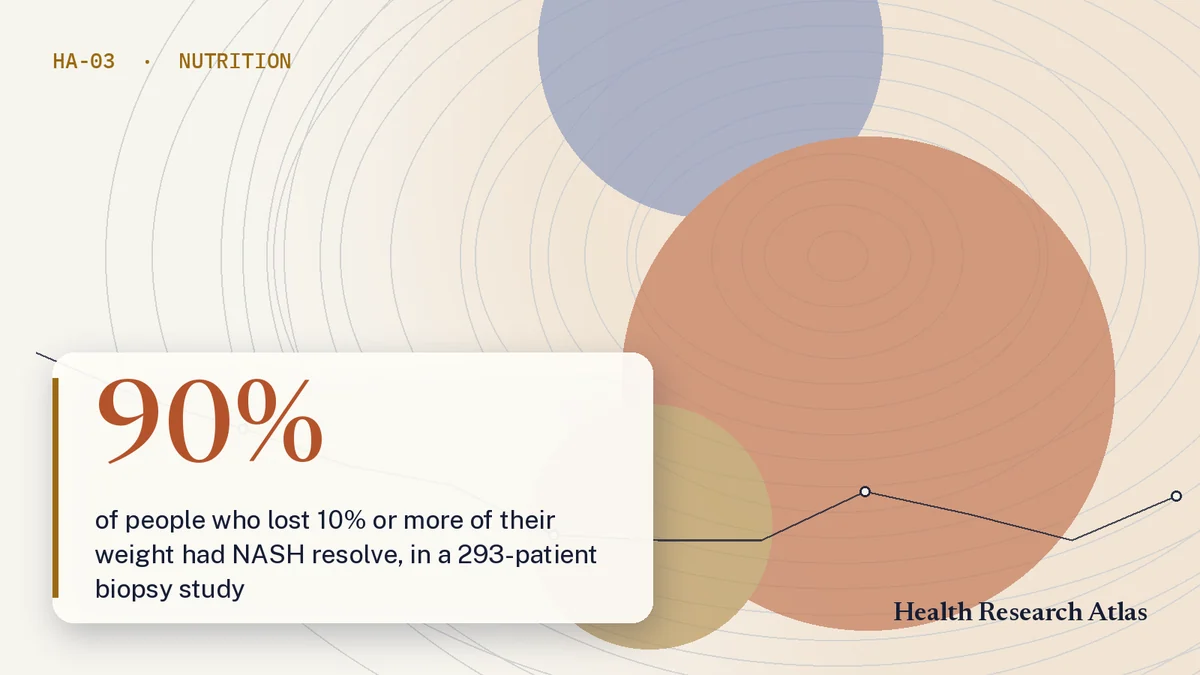
Much of this evidence comes from a landmark 2015 study by Vilar-Gomez and colleagues in Gastroenterology. It followed 293 adults with biopsy-proven NASH in Havana, Cuba, who were advised to change their lifestyle for 52 weeks, and repeated liver biopsies in 261 of them. Overall, 25% had resolution of NASH and 19% had fibrosis regression. Among those who lost 10% or more of their weight, 90% had resolution of NASH and 45% had regression of fibrosis. It was a cohort study, not a randomised trial, so it shows a strong link between weight loss and healing rather than proving the exact percentages for any one person.
The same study shows the hard part: only 30% of participants lost 5% or more of their body weight in a year. The AASLD guidance likewise notes that "Few patients (≤10%) achieve effective weight loss despite structured interventions at 1 year". A diet you can keep to matters more than a dramatic one you abandon.
Fatty liver diet vs the Mediterranean diet
When guidelines talk about a fatty liver diet, they mostly mean a Mediterranean pattern. The European guideline recommends "improving diet quality (similar to the Mediterranean dietary pattern), limiting the consumption of ultra-processed food (rich in sugars and saturated fat) and avoiding sugar-sweetened beverages" to improve liver injury, and says the Mediterranean diet "seems to have added value for liver lipid reduction and cardiometabolic health". The US guidance encourages diets "with limited carbohydrates and saturated fat and enriched with high fiber and unsaturated fats", giving the Mediterranean diet as the example, partly because "it is sustainable and has cardiovascular benefit."
The trial evidence is promising but small:
- In a randomised crossover trial in Melbourne, Ryan and colleagues (2013) gave 12 adults with biopsy-proven fatty liver 6 weeks of a Mediterranean diet and 6 weeks of a low-fat, high-carbohydrate diet based on Australian National Heart Foundation and American Heart Association advice. Liver fat, measured by MR spectroscopy, fell by 39% on the Mediterranean diet and by about 7% on the low-fat diet, even though weight loss did not differ between the diets. The authors describe the study as small and call for a larger trial.
- A 2022 systematic review and meta-analysis by Haigh and colleagues in Clinical Nutrition pooled 26 studies with 3,037 participants. Calorie restriction reduced the liver enzyme ALT, liver fat and liver stiffness, with bigger benefits the more calories were cut. The Mediterranean diet reduced ALT and the Fatty Liver Index. The authors concluded that "the limited data suggest that MD may be an effective diet therapy."
In practice the two approaches combine well: a Mediterranean-style diet eaten in slightly smaller amounts gives both the calorie deficit and the better food quality the guidelines ask for. If you are not overweight, the European guideline still recommends diet and exercise to reduce liver fat.
Fatty liver diet food list: what to eat and what to limit
The list below is built from the foods named in the guidelines and in the Mediterranean diet used in the Melbourne trial, which was high in monounsaturated fat from olive oil and included omega-3 fats from plant and marine sources. It is a pattern, not a prescription.
| Eat more often | Limit or avoid |
|---|
| Extra virgin olive oil as the main fat | Sugar-sweetened drinks (fizzy drinks, sweetened juices and similar) |
| Oily fish and other fish | Foods and drinks with added sugars, especially fructose |
| Nuts and olives | Ultra-processed foods high in sugar and saturated fat |
| High-fibre plant foods | Refined carbohydrates |
| Greek yoghurt | Red and processed meat |
| Unsaturated fats in place of saturated fats | Alcohol (see below) |
Two points deserve emphasis. First, the European guideline says sugar-sweetened drinks and red meat were linked to a higher risk of developing MASLD "in a dose-dependent manner", meaning the more people consumed, the higher the risk. These are observational findings, so they show a link rather than proof of cause. Second, the AASLD guidance names "excess saturated fats, refined carbohydrates, and sugar-sweetened beverages" as the parts of an excess-calorie diet most associated with obesity and fatty liver.
Our nutrition hub collects more evidence explainers on food and health.
Alcohol with fatty liver: how much is too much?
The US guidance describes alcohol as "a cofactor for liver disease progression", and the guidelines are stricter than many people expect:
- The European guideline says people with steatotic liver disease, "particularly those with moderate or high alcohol intake, should be discouraged from consuming alcohol", and that "any level of alcohol consumption, even within recommended limits, is associated with worsening of liver outcomes in MASLD". It does not support the idea that light drinking protects the liver.
- Both guidelines say to stop completely if there is significant scarring. The European guideline says all alcohol "should be stopped completely and permanently in individuals with advanced fibrosis or cirrhosis"; the US guidance says people with clinically significant fibrosis (stage F2 or above) "should abstain from alcohol use completely."
The new naming system also uses alcohol bands. Under the European guideline, someone with MASLD who drinks 20 to 50 g of alcohol a day (women) or 30 to 60 g a day (men) is classed as having MetALD, a mixed metabolic and alcohol-related disease. In the US guidance, the old NAFLD label applied to people drinking less than 20 g a day (women) or 30 g a day (men). If you are unsure how your usual drinks convert to grams of alcohol, ask your clinician.
Coffee, keto, fasting and supplements
Coffee is where the guidelines differ most. The US guidance says coffee "(caffeinated or not) of at least three cups daily is associated with less advanced liver disease" and that three or more cups a day "could be recommended in the absence of contraindications". The European guideline agrees the observational link exists but concludes that "no firm conclusions can be drawn", because these studies are open to confounding and trials are scarce. So coffee is associated with better liver health, but it has not been proven to treat fatty liver.
Very low-carbohydrate ketogenic diets and time-restricted eating: the European guideline finds "insufficient evidence on the efficacy or safety" of ketogenic diets and "very little evidence" that time-restricted eating beats ordinary calorie restriction. In other words, there is no proven extra benefit for the liver.
Supplements and "liver detox" products: the European guideline states that "nutraceuticals cannot be recommended since there is insufficient evidence of their effectiveness."
Exercise alongside diet
Both guidelines pair diet with physical activity, which the European guideline recommends to reduce liver fat. The European guideline recommends physical activity tailored to the person, "preferably ≥150 min/week of moderate or 75 min/week of vigorous-intensity physical activity". The US guidance describes the same 150 minutes as "at least five times per week", and notes that increasing activity by more than 60 minutes a week can prevent or improve fatty liver. Raised blood sugar is one of the MASLD risk factors; our HbA1c explainer covers how it is measured.
When to talk to a doctor. This article is general information, not a personal plan. Ask your doctor or a registered dietitian before a major diet change if you have diabetes or take blood sugar-lowering medicines, if you have been told you have liver scarring or cirrhosis (where alcohol must stop completely), or if you are not losing weight despite sustained effort. The European guideline says bariatric surgery should be considered for adults without cirrhosis who have an approved indication for it.
How strong is the evidence?
We grade this article moderate (see how we grade evidence). The advice to lose weight, improve diet quality and be more active is a strong recommendation in current guidelines, and the link between the amount of weight lost and liver healing comes from biopsy studies. But the European guideline itself notes "little evidence that improving diet quality beneficially impacts clinical liver-related outcomes", such as cirrhosis or liver cancer: trials measure liver fat, enzymes and biopsy changes over months, not long-term outcomes. The Mediterranean diet trials are small, and coffee and red meat findings are largely observational.
What we still don't know
Researchers still need long-term trials showing that a particular diet prevents cirrhosis, liver cancer or death, not just that it lowers liver fat. The Mediterranean diet needs testing in larger trials, as the Melbourne authors themselves say. The European guideline finds too little evidence to judge ketogenic or time-restricted eating, and with so few people reaching 10% weight loss in a year, better ways to support lasting change are a priority.
Frequently asked questions
What is the best diet for fatty liver?
Current US and European guidelines favour a Mediterranean-style diet: more unsaturated fats such as olive oil, fish, nuts and high-fibre foods, and less sugar, refined carbohydrate, saturated fat, ultra-processed food and red or processed meat. If you are overweight, eating in a way that creates a calorie deficit matters most.
What foods should I avoid with fatty liver?
Guidelines single out sugar-sweetened drinks, foods with added sugars (especially fructose), ultra-processed foods high in sugar and saturated fat, refined carbohydrates, and red and processed meat. Alcohol should be limited or avoided, and stopped completely if there is significant scarring.
How much weight do I need to lose to reverse fatty liver?
European guidance says a sustained loss of at least 5% of body weight reduces liver fat, 7% to 10% improves inflammation and at least 10% improves fibrosis. US guidance says 3% to 5% improves fat and more than 10% is generally needed for inflammation and fibrosis.
Is coffee good for fatty liver?
Drinking at least three cups a day is linked with less advanced liver disease in observational studies, and US guidance says it could be recommended if there is no reason to avoid it. European guidance says no firm conclusions can be drawn, so coffee is not a treatment.
Is the Mediterranean diet better than a low-fat diet for fatty liver?
In a small Australian crossover trial, liver fat fell 39% on a Mediterranean diet versus about 7% on a low-fat diet, without a difference in weight loss. A 2022 meta-analysis found the Mediterranean diet lowered liver enzymes, but larger trials are still needed.
Sources
- European Association for the Study of the Liver (EASL), European Association for the Study of Diabetes (EASD), European Association for the Study of Obesity (EASO); panel chair Tacke F. EASL-EASD-EASO Clinical Practice Guidelines on the management of metabolic dysfunction-associated steatotic liver disease (MASLD). J Hepatol. 2024;81:492-542. doi:10.1016/j.jhep.2024.04.031
- Rinella ME, Neuschwander-Tetri BA, Siddiqui MS, Abdelmalek MF, Caldwell S, Barb D, Kleiner DE, Loomba R. AASLD Practice Guidance on the clinical assessment and management of nonalcoholic fatty liver disease. Hepatology. 2023;77(5):1797-1835. doi:10.1097/HEP.0000000000000323
- Vilar-Gomez E, Martinez-Perez Y, Calzadilla-Bertot L, et al. Weight loss through lifestyle modification significantly reduces features of nonalcoholic steatohepatitis. Gastroenterology. 2015;149(2):367-378.e5. doi:10.1053/j.gastro.2015.04.005
- Haigh L, Kirk C, El Gendy K, Gallacher J, Errington L, Mathers JC, Anstee QM. The effectiveness and acceptability of Mediterranean diet and calorie restriction in non-alcoholic fatty liver disease (NAFLD): a systematic review and meta-analysis. Clin Nutr. 2022;41(9):1913-1931. doi:10.1016/j.clnu.2022.06.037
- Ryan MC, Itsiopoulos C, Thodis T, Ward G, Trost N, Hofferberth S, O'Dea K, Desmond PV, Johnson NA, Wilson AM. The Mediterranean diet improves hepatic steatosis and insulin sensitivity in individuals with non-alcoholic fatty liver disease. J Hepatol. 2013. doi:10.1016/j.jhep.2013.02.012 (PubMed 23485520)
This article is for general information and isn't a substitute for advice from your doctor or another qualified health professional. See our medical disclaimer and editorial standards. Spotted an error? Tell us.