Zone 2 cardio is steady, low-intensity aerobic exercise done just below your first lactate threshold: the point where lactate starts to build up in the blood. In practice it feels easy to moderate, you can hold a conversation with some effort, and for many people it lands at roughly 67% to 82% of maximum heart rate, although that range varies a lot from person to person.
Zone 2 has become one of the most talked-about ideas in fitness and longevity, often promoted as the best way to build mitochondria and burn fat. This guide explains what zone 2 actually is, how to estimate your zone 2 heart rate (and why formulas can be wrong), and what a 2025 Sports Medicine review found when it checked those claims against the research.
What is zone 2 cardio?
Exercise scientists divide effort into intensity "zones" based on how the body responds. In 2025, a panel of 14 sport scientists and professional coaches published an expert viewpoint on zone 2 and agreed it should "preferably be performed at intensities located immediately below the first lactate or ventilatory threshold". The first lactate threshold (often called LT1) is the effort level at which blood lactate first rises above resting levels; the first ventilatory threshold is the point where breathing starts to speed up noticeably.
The same panel admitted that "there is no clear consensus among coaches, athletes, and scientists regarding the definition of zone 2 training". Different apps, watches and coaches use different zone systems, so "zone 2" on one device may not match zone 2 on another.
Because zone 2 is tied to your own physiology rather than a fixed speed, the absolute effort differs hugely. The Sports Medicine review notes that zone 2 can sit anywhere from about 24% to 80% of a person's maximal oxygen uptake (VO2max), depending on fitness. For a sedentary person it may be brisk walking; for a trained endurance athlete it can be fast cycling.
Zone 2 heart rate: how to estimate it
The most accurate way to find zone 2 is a lab test that measures blood lactate or breathing gases. Without one, people use heart rate, perceived effort or the talk test. The expert panel described zone 2 as:
| Marker | Typical zone 2 value | Source |
|---|
| Blood lactate | About 1 to 2 mmol/L | Sitko et al. 2025 expert panel |
| Heart rate | About 67% to 82% of maximum (text gives about 70% to 80%) | Sitko et al. 2025 |
| Perceived effort | About 9 to 12 on the 6 to 20 Borg scale | Sitko et al. 2025 |
| Talk test | Can converse with some effort | Sitko et al. 2025 |
To turn a percentage into beats per minute, you need your maximum heart rate. The American Heart Association uses the common shortcut that maximum heart rate is "about 220 minus your age". An alternative, the Tanaka formula (208 minus 0.7 times age), came from a 2001 meta-analysis of 351 studies and 18,712 people. Its authors found that 220 minus age "significantly underestimates HRmax in older adults".
The table below applies the expert panel's 67% to 82% range to both formulas. These are our calculations, not targets from a guideline, and they are only rough estimates.
| Age | Estimated zone 2 (220 minus age) | Estimated zone 2 (Tanaka formula) |
|---|
| 30 | 127–156 bpm | 125–153 bpm |
| 40 | 121–148 bpm | 121–148 bpm |
| 50 | 114–139 bpm | 116–142 bpm |
| 60 | 107–131 bpm | 111–136 bpm |
| 70 | 100–123 bpm | 107–130 bpm |
Two big caveats apply. First, your true maximum heart rate can differ quite a bit from any formula's estimate: the Tanaka study reported a standard deviation of about 10 beats per minute. Second, fixed percentages do not match everyone's physiology. In a 2025 study of 50 experienced cyclists, fixed percentages of maximum heart rate and lactate thresholds "exhibited wide individual differences", and the zone 2 heart rate and power boundaries had a coefficient of variation above 20% between riders. On average, the riders' first ventilatory threshold fell at 81.4% of maximum heart rate.
Zone 2 vs "moderate intensity" in the guidelines
Public health guidelines do not use the term zone 2. They talk about moderate and vigorous intensity, and the boundaries do not line up neatly:
- US: the American Heart Association puts moderate intensity at about 50% to 70% of maximum heart rate and vigorous at about 70% to 85%. The CDC defines moderate activity as 3 to 5.9 METs (multiples of resting energy use), or a 5 or 6 on a 0 to 10 effort scale.
- UK: the NHS says moderate activity "will raise your heart rate, and make you breathe faster and feel warmer".
- Talk test (both): the NHS and CDC both say that at moderate intensity you can talk but not sing. At vigorous intensity you cannot say more than a few words without pausing for breath.
So zone 2, as the expert panel defines it, overlaps the upper part of the AHA's moderate range and the lower part of its vigorous range. The Sports Medicine review warns the overlap can go the other way for some people: zone 2 "may fall below the moderate- to vigorous-intensity range recommended by physical activity guidelines".
Is walking zone 2 cardio?
It can be. The CDC lists brisk walking (2.5 miles per hour or faster) as moderate-intensity activity, and the Sports Medicine review gives walking as an example of zone 2 for sedentary people. For a fit person, though, walking may be too easy to reach zone 2 and they may need to jog, cycle or walk uphill. The simplest check is the talk test: if you can chat comfortably but with some effort, you are probably in the right range.
Zone 2 cardio benefits: what the research shows
Claims for zone 2 usually centre on mitochondria (the parts of muscle cells that produce energy aerobically), fat burning and VO2max. The evidence is more modest than the marketing.
Where the idea came from. Elite endurance athletes do a lot of easy training. The Sports Medicine review, by researchers at Queen's University and McMaster University in Canada, says the popular recommendations "largely stem from observational data of elite endurance athletes", who often train more than 20 hours a week and do high volumes of both low- and high-intensity work. The review concludes that athletes' high mitochondrial capacity "is more related to their training spent above Zone 2".
Mitochondria and fat burning. The review found that "few studies have explicitly investigated" zone 2's effect on mitochondria, and concluded that current evidence "does not support Zone 2 training as the optimal intensity for improving mitochondrial or fatty acid oxidative capacity". It does note that zone 2 training "does appear to increase fat oxidative capacity"; it just is not shown to do so better than harder exercise. The expert panel similarly lists expected adaptations such as more capillaries in muscle and more mitochondrial enzymes, while stating that "scientific evidence is still lacking" and that these changes "might not be unique to zone 2".
VO2max and fitness. VO2max, the most oxygen your body can use during hard exercise, is the standard measure of cardiorespiratory fitness. A 2015 meta-analysis of 28 studies (723 healthy adults aged 18 to 45) found that both approaches work well:
| Comparison | Average VO2max gain |
|---|
| Continuous endurance training vs no exercise | +4.9 mL/kg/min |
| High-intensity interval training (HIT) vs no exercise | +5.5 mL/kg/min |
| HIT vs continuous endurance training | +1.2 mL/kg/min in favour of HIT (a "possibly small" extra benefit) |
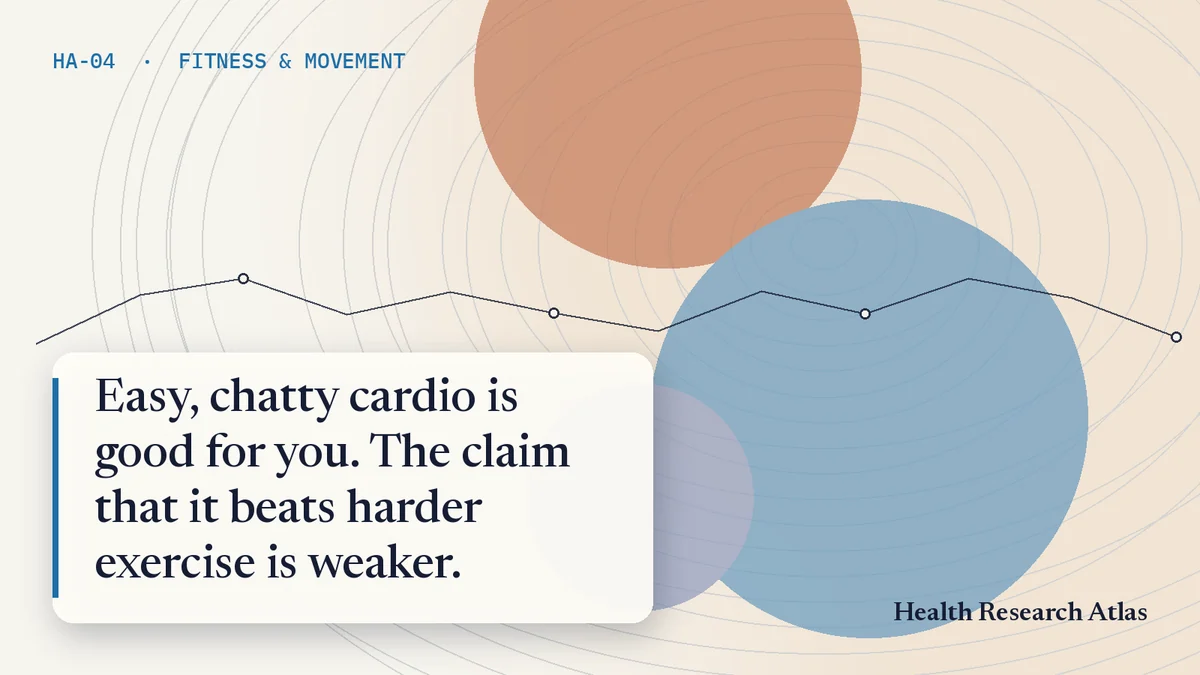
The 2025 review reaches a similar conclusion: "for a fixed amount of exercise, higher exercise intensities result in greater improvements" in fitness, so harder efforts matter most when training time is limited. Its authors stress they "do not question the health benefits of physical activity, which includes that done at low intensity". Their challenge is to the idea that zone 2 is the single best intensity for the general public.
How much zone 2 cardio do you need?
No guideline sets a zone 2 target. The WHO 2020 guidelines say all adults should do 150 to 300 minutes of moderate-intensity or 75 to 150 minutes of vigorous-intensity activity a week, or a mix, plus muscle-strengthening on 2 or more days. The guidance differs slightly by country:
- UK (NHS): at least 150 minutes moderate or 75 minutes vigorous a week, spread over 4 to 5 days or every day, plus strengthening on at least 2 days.
- Australia: the Department of Health recommends moderate- to vigorous-intensity activity for 30 minutes or more on most days, plus muscle-strengthening on 2 or more days.
- Bout length: WHO removed the old rule that activity had to come in bouts of at least 10 minutes; bouts "of any duration" now count.
Zone 2 sessions can count towards these totals when they reach moderate intensity. Because the evidence favours some harder work for fitness, a common-sense reading of the research is to mix steady sessions with some vigorous effort if you are able, rather than doing only zone 2. WHO's core message still applies: "doing some physical activity is better than doing none."
For more on exercise evidence, see our fitness and movement hub.
Who should check before using heart rate zones
Talk to a doctor first if you have a heart condition or take medicines that affect heart rate. The American Heart Association notes that "some drugs and medications affect heart rate, meaning you may have a lower maximum heart rate and target zone", and advises people with a heart condition or on medication to ask a health professional what their heart rate should be. The Tanaka formula was also developed in healthy adults who did not smoke, take medication or have known heart disease, so it may not apply if any of those describe you. If you feel unwell during exercise, stop and get medical advice.
How strong is the evidence?
We rate this topic as moderate evidence (see how we grade evidence). The physical activity guidelines rest on large bodies of research, and the comparison of interval and continuous training comes from a meta-analysis of controlled trials. But the specific claims about zone 2 rely mostly on expert opinion, narrative reviews and small studies, and few randomised controlled trials have tested zone 2, as precisely defined, against other intensities in ordinary adults.
What we still don't know
- Whether zone 2 training improves long-term outcomes such as heart disease or lifespan any differently from other moderate activity.
- The best mix of easy and hard training for people who are not athletes.
- How well heart rate zones on consumer watches match lactate-based zone 2 in everyday users; the cyclist study suggests individual variation is large.
Frequently asked questions
What is zone 2 cardio?
Zone 2 cardio is steady aerobic exercise done just below your first lactate threshold, where lactate starts to rise in the blood. It usually feels easy to moderate, and you can hold a conversation with some effort.
What heart rate is zone 2?
A 2025 expert panel described zone 2 as roughly 67% to 82% of maximum heart rate. For a 40-year-old using 220 minus age, that is about 121 to 148 beats per minute, but individual zones vary a lot and only a lab test can pin it down.
Is walking zone 2 cardio?
Brisk walking can be zone 2, especially for people who are less fit. Fitter people may need to walk uphill, jog or cycle to reach it; if you can talk but with some effort, you are probably close.
Is zone 2 better than HIIT?
Not according to current evidence. A 2025 review concluded zone 2 is not the optimal intensity for improving mitochondria or cardiorespiratory fitness, and a 2015 meta-analysis found interval training raised VO2max slightly more than continuous training.
How much zone 2 cardio should I do a week?
No guideline sets a zone 2 target. WHO recommends 150 to 300 minutes of moderate or 75 to 150 minutes of vigorous activity a week, and zone 2 sessions can count towards that when they reach moderate intensity.
Sources
- Storoschuk KL, Moran-MacDonald A, Gibala MJ, Gurd BJ. Much Ado About Zone 2: A Narrative Review Assessing the Efficacy of Zone 2 Training for Improving Mitochondrial Capacity and Cardiorespiratory Fitness in the General Population. Sports Med. 2025;55(7):1611-1624. doi:10.1007/s40279-025-02261-y
- Sitko S, Artetxe X, Bonnevie-Svendsen M, Galán-Rioja MÁ, Gallo G, Grappe F, et al. What Is "Zone 2 Training"?: Experts' Viewpoint on Definition, Training Methods, and Expected Adaptations. Int J Sports Physiol Perform. 2025;20(11):1614-1617. doi:10.1123/ijspp.2024-0303
- Meixner B, Filipas L, Holmberg HC, Sperlich B. Zone 2 Intensity: A Critical Comparison of Individual Variability in Different Submaximal Exercise Intensity Boundaries. Transl Sports Med. 2025;2025:2008291. doi:10.1155/tsm2/2008291
- Milanović Z, Sporiš G, Weston M. Effectiveness of High-Intensity Interval Training (HIT) and Continuous Endurance Training for VO2max Improvements: A Systematic Review and Meta-Analysis of Controlled Trials. Sports Med. 2015;45(10):1469-1481. doi:10.1007/s40279-015-0365-0
- Tanaka H, Monahan KD, Seals DR. Age-predicted maximal heart rate revisited. J Am Coll Cardiol. 2001;37(1):153-156. doi:10.1016/S0735-1097(00)01054-8
- Bull FC, Al-Ansari SS, Biddle S, Borodulin K, Buman MP, Cardon G, et al. World Health Organization 2020 guidelines on physical activity and sedentary behaviour. Br J Sports Med. 2020;54(24):1451-1462. doi:10.1136/bjsports-2020-102955
- NHS. Physical activity guidelines for adults aged 19 to 64. Last reviewed May 2024. nhs.uk
- Centers for Disease Control and Prevention. How to Measure Physical Activity Intensity. Last reviewed December 2025. cdc.gov
- American Heart Association. Target Heart Rates Chart. Last reviewed August 2024. heart.org
- Australian Government Department of Health, Disability and Ageing. Recommendations for adults (18 to 64 years). health.gov.au
This article is for general information and isn't a substitute for advice from your doctor or another qualified health professional. See our medical disclaimer and editorial standards. Spotted an error? Tell us.