Dermoid Cyst With Hair and Teeth: Why It Happens, Risks and Treatment
A cyst containing hair and teeth sounds alarming, but ovarian dermoid cysts are common and usually benign. Here is why they form and what the evidence says about risks.
From changing periods and night sweats to low mood and brain fog: what the run-up to menopause can feel like, why figures for how long it lasts differ, how it's diagnosed in the US, UK and Australia, and which treatments work.
The most common perimenopause symptoms are changes to your periods, hot flushes (hot flashes) and night sweats, poor sleep, and shifts in mood. They usually begin in your mid to late 40s, can come and go for several years, and end gradually after your final period.
Perimenopause is the run-up to menopause, when hormone levels from the ovaries rise and fall unpredictably before they settle at a low level. Not everyone notices it: Australia's Department of Health says about a quarter of women have no symptoms, while around 1 in 4 have symptoms severe enough to affect daily life.
Menopause itself is a single point in time: it is defined as not having had a period for 12 months (when you aren't using hormonal contraception). Perimenopause is the stage before it. Healthdirect Australia describes it as beginning when periods become irregular and lasting until 12 months after the final period.
Researchers divide this transition into stages using the STRAW+10 staging system, an international consensus published in 2012 that remains the reference standard. It defines the stages mainly by period patterns:
| Stage (STRAW+10) | What happens to periods | What to expect |
|---|---|---|
| Early menopausal transition | The length of your cycle changes by 7 days or more from one cycle to the next, and this happens again within 10 cycles | Periods still come, but less predictably |
| Late menopausal transition | A gap of 60 days or more without a period | Lasts 1 to 3 years on average; hot flushes and night sweats are likely |
| Menopause (final period) | No period for 12 months, confirmed looking back | Symptoms may continue for some years |
Period-based stages can't be used if you've had a hysterectomy or your bleeding is controlled by hormonal contraception. NICE says that after a hysterectomy, diagnosis is based on the type and combination of symptoms instead.
Both the NHS and Healthdirect say the menopause transition usually happens between the ages of 45 and 55. The average age of menopause is 51, according to Healthdirect, and Healthdirect estimates perimenopause itself lasts about 4 to 8 years, so for many people the first changes appear in their 40s.
It can start earlier. Menopause between 40 and 45 is called early menopause, and before 40 it is called premature menopause or premature ovarian insufficiency. Symptoms that look like perimenopause in your 30s or early 40s are worth discussing with a doctor, because NICE recommends a different approach for people under 45, which can include blood tests.
For most people, the NHS says, "one of the first signs of perimenopause is usually a change to your periods." Early signs often include:
Hot flushes don't always wait for period changes. In the large US Study of Women's Health Across the Nation (SWAN), some women first noticed frequent hot flushes while they were still premenopausal or in early perimenopause.
NICE's menopause quality standard groups symptoms into vasomotor, mood, genitourinary, musculoskeletal and sexual effects. The table brings together the symptoms listed by the NHS and Healthdirect.
| Type | Symptoms |
|---|---|
| Periods | More or less frequent, heavier or lighter, longer or shorter |
| Vasomotor | Hot flushes and night sweats, palpitations (a fast or pounding heartbeat) |
| Sleep and energy | Difficulty sleeping, tiredness |
| Mood and thinking | Mood swings, low mood or depression, anxiety, irritability, poor memory and concentration ("brain fog") |
| Vaginal and urinary | Vaginal dryness and burning, more urinary tract infections or UTI-like symptoms, urinary incontinence |
| Body | Muscle aches and joint pains, headaches and migraines, sore breasts, weight gain around the stomach, dry or itchy skin, thinning hair, sensitive teeth and painful gums |
| Sex | Reduced sex drive |
How common are they? Estimates vary. Australia's Department of Health puts hot flushes at around 80% of women, and The Menopause Society in the US says "up to 80%". A 2023 review in JAMA gives a more conservative 50% to 75% for hot flushes, night sweats or both, and says more than half of women get genitourinary symptoms such as vaginal dryness. The differences reflect who was surveyed and how symptoms were counted.
Many of these symptoms have other causes too, so the list is a guide, not a diagnostic checklist. More explainers are in our Women's Health section.
Published figures disagree, partly because some count perimenopause only and others count symptoms before and after the final period.
| Source | Figure |
|---|---|
| Australian Department of Health | Symptoms last 4 to 6 years on average |
| Healthdirect (Australia) | Symptoms can last 5 to 10 years |
| NHS (UK) | Usually 7 to 9 years, sometimes longer |
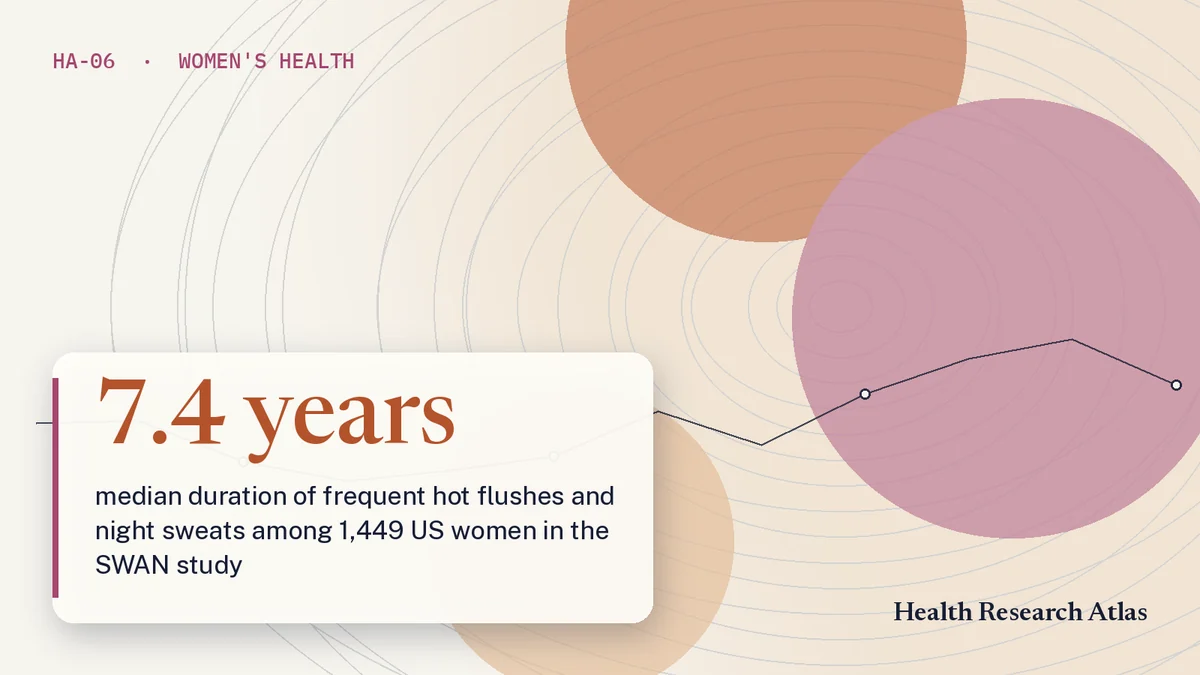
| SWAN study (US) | Median 7.4 years of frequent hot flushes and night sweats |
The SWAN figure comes from a cohort study that followed 3,302 women at seven US sites, 1,449 of whom had frequent hot flushes or night sweats. Two findings stand out. First, timing matters: women whose hot flushes started while they were premenopausal or in early perimenopause had them for longest (a median of more than 11.8 years), while those whose symptoms began after menopause had them for a median of 3.4 years. Second, duration differed by ethnicity, from a median of 4.8 years in Japanese women and 6.5 years in non-Hispanic white women to 8.9 years in Hispanic women and 10.1 years in African American women. Hot flushes persisted for a median of 4.5 years after the final period.
In other words, symptoms lasting for years are common. The NHS notes that some, such as joint pain and vaginal dryness, can continue after menopause.
Low mood is one of the symptoms people are least prepared for. A 2024 meta-analysis in the Journal of Affective Disorders, pooling seven studies with 9,141 participants, found perimenopausal women had about 40% higher odds of depressive symptoms or a depression diagnosis than premenopausal women (odds ratio 1.40, 95% confidence interval 1.21 to 1.61). Postmenopausal women did not have a clearly raised risk compared with premenopausal women.
These are observational studies, so they show an association, not proof that hormones alone are the cause. Mood changes still deserve to be taken seriously: NICE advises considering HRT for low mood that arises as a result of the menopause, and CBT for low mood or anxiety.
Usually without a blood test. Under NICE guideline NG23 in the UK, people aged 45 or over who are otherwise healthy are diagnosed with perimenopause based on symptoms alone: recently started hot flushes or night sweats plus a change in their periods. NICE explains that follicle-stimulating hormone (FSH) tests don't help in this group because FSH levels swing up and down through perimenopause, so a single result can be misleading.
Hormonal contraception can hide period changes, and NICE advises against using an FSH test to diagnose menopause in people taking combined (oestrogen and progestogen) contraception or high-dose progestogen. If that applies to you, talk to your doctor about your symptoms rather than relying on a test.
Treatment depends on which symptoms bother you, your health history and your preferences. The best-supported options are:
What about supplements? Healthdirect says there is "no strong evidence" that supplements and herbal remedies work for perimenopausal symptoms, and the NHS says there is very little evidence on how well remedies such as black cohosh and red clover work or how safe they are, and that some can cause serious side effects when taken with other medicines. The Menopause Society reports limited or negative evidence for supplements, yoga, acupuncture and cooling techniques for hot flushes, though a healthy diet and regular exercise matter for long-term health. Because symptoms naturally come and go, trials that compare a treatment with a placebo are needed to judge whether it really works.
One more practical point: you can still get pregnant during perimenopause. Healthdirect advises talking to your doctor about contraception until menopause is confirmed, and NICE asks clinicians to give contraception information to people in perimenopause.
See a GP or family doctor if symptoms are bothering you or affecting daily life. You don't need to wait until your periods stop.
We grade this article moderate. The list of symptoms, the age range and the advice that blood tests aren't needed over 45 are consistent across NICE, the NHS, Healthdirect and the Australian Department of Health. Treatment effects for HRT and non-hormonal medicines come from randomised controlled trials summarised in the JAMA review and NICE. Figures for how common and how long-lasting symptoms are come from cohort studies and surveys and vary with population and definitions, so treat any single number as approximate.
Researchers still can't reliably predict who will have severe or long-lasting symptoms, or fully explain why duration differs so much between ethnic groups. The SWAN duration figures come from women in the US and may not apply everywhere.
Usually a change in your periods: they may come more or less often, or be heavier or lighter. Hot flushes, night sweats, poor sleep and mood changes are also common early signs.
The menopause transition usually happens between 45 and 55, and the average age of menopause is 51, so many people notice changes in their 40s. Menopause before 45 is called early, and before 40 premature.
It varies. Australian government sources give 4 to 6 years on average, the NHS says 7 to 9 years, and the US SWAN study found a median of 7.4 years of frequent hot flushes, with longer durations when they began early.
Usually not needed. NICE says people aged 45 or over can be diagnosed from symptoms alone because FSH levels fluctuate. An FSH test may be considered for people under 45.
Yes. Pregnancy is still possible until menopause is confirmed, so Healthdirect advises talking to your doctor about contraception.
This article is for general information and isn't a substitute for advice from your doctor or another qualified health professional. See our medical disclaimer and editorial standards. Spotted an error? Tell us.
A cyst containing hair and teeth sounds alarming, but ovarian dermoid cysts are common and usually benign. Here is why they form and what the evidence says about risks.
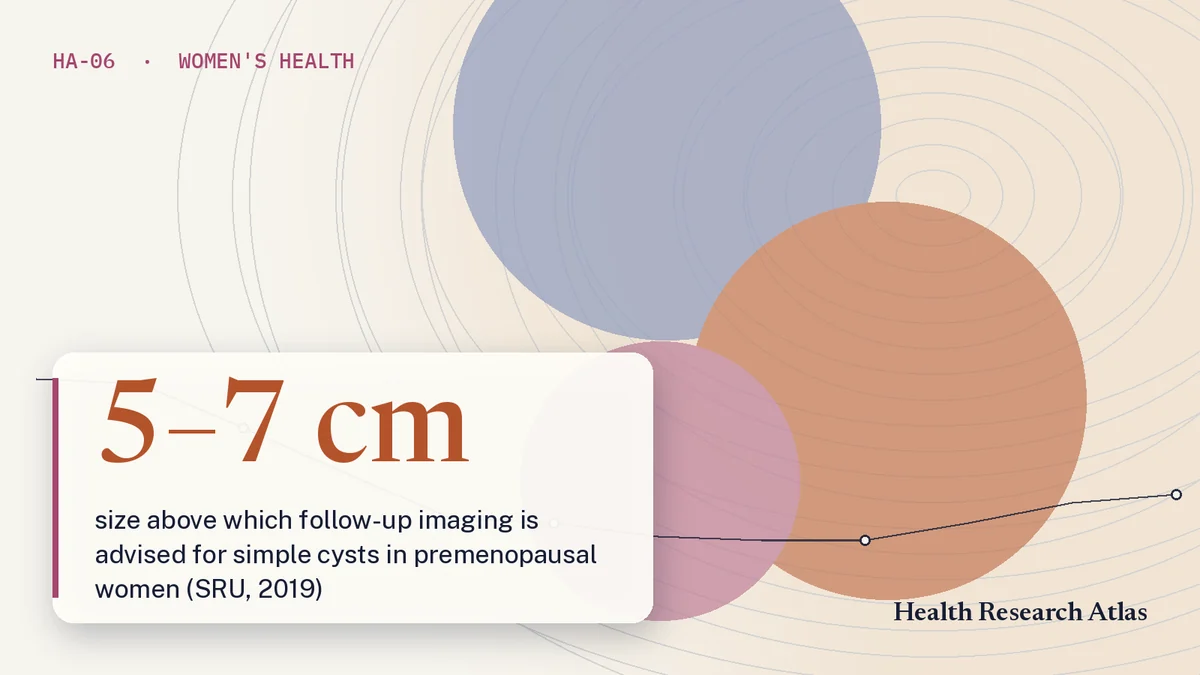
A 5 cm cyst is about the size of a lime. For many women it is harmless and goes away on its own. Here is what size really tells you, and when to get it checked.
BUN appears on routine kidney blood tests. Here's what it measures, how US mg/dL and UK or Australian mmol/L results compare, what high and low levels can point to, and why doctors rely on eGFR to judge kidney function.