A 5 cm cyst on the ovary is about 2 inches across, roughly the size of a lime or a golf ball. It sounds large, but for many women of reproductive age a simple, fluid-filled cyst of this size is common, harmless and often goes away on its own within a few menstrual cycles. What matters most is not only the size but what the cyst looks like on ultrasound, your age and whether you have symptoms.
Is a 5 cm ovarian cyst big?
Ovarian cysts are measured by their largest diameter. For context:
| Size | Roughly | What it usually means |
|---|
| Up to 3 cm | A grape or cherry | Often a normal follicle before ovulation in premenopausal women |
| 3–5 cm | A walnut to a lime | Commonly a functional cyst; frequently resolves on its own |
| 5–7 cm | A lime to a lemon | Often still benign; follow-up ultrasound may be suggested |
| Over 7 cm | Larger than a lemon | More likely to need further imaging or a surgical opinion |
So 5 cm sits at the boundary where doctors start to consider follow-up, but it is not, on its own, a sign of something serious.
Simple vs complex cysts: why appearance matters more than size
A simple cyst has a thin, smooth wall and contains only clear fluid, with no solid parts. Large studies have found that simple cysts carry an extremely low risk of cancer, whatever their size. A complex cyst has features such as thick walls, internal divisions, solid areas or blood flow inside. Most complex cysts are still benign, for example dermoid cysts, endometriomas and haemorrhagic cysts, but they are more likely to need further assessment.
Radiologists increasingly describe cysts using standardised systems such as O-RADS (Ovarian-Adnexal Reporting and Data System), which grades the risk of cancer from almost none to high based on appearance.
What the guidelines say about a 5 cm simple cyst
In 2019 the Society of Radiologists in Ultrasound (SRU) updated its consensus guidance on simple ovarian (adnexal) cysts in women without symptoms, reflecting large studies showing a very low cancer risk. The key thresholds are:
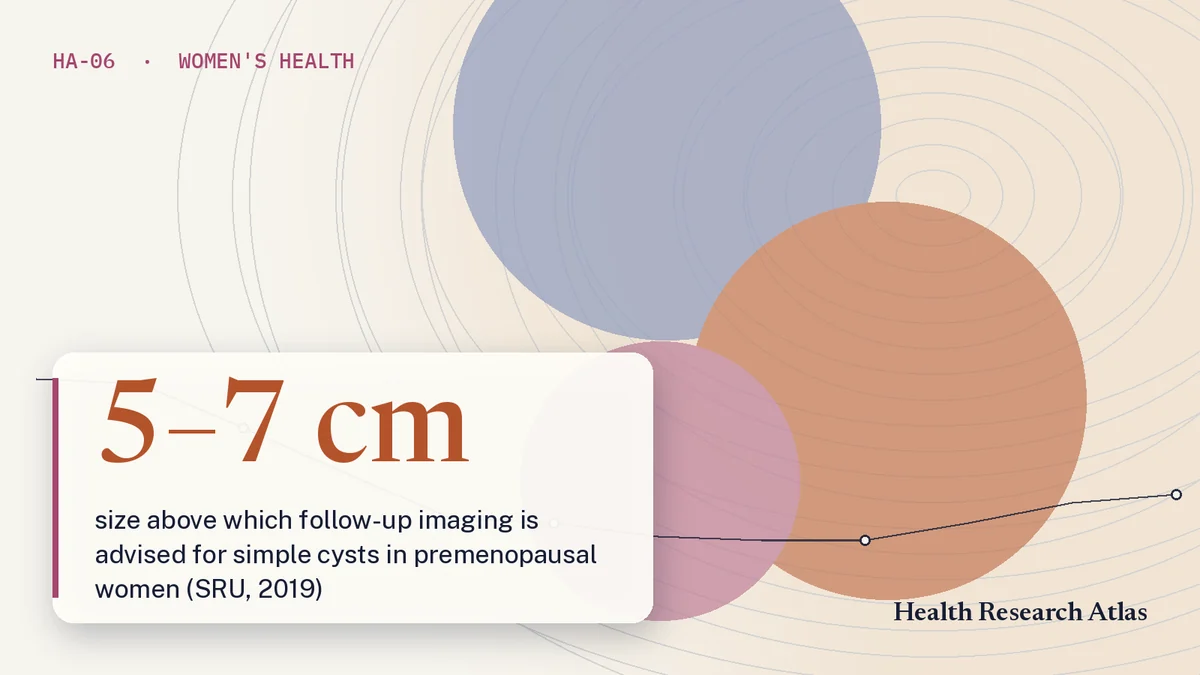
- Premenopausal women: simple cysts of 3 cm or less are normal and don't need to be reported. Follow-up imaging is recommended only for simple cysts larger than 5–7 cm, with the higher threshold used when the cyst is very clearly seen.
- Postmenopausal women: simple cysts larger than 1 cm should be noted in the report, but follow-up imaging is recommended only for cysts larger than 3–5 cm.
- If a cyst shrinks by at least 10–15% on a follow-up scan, no further follow-up is needed.
UK guidance (RCOG)
The UK RCOG Green-top Guideline No. 62 for premenopausal women uses slightly different cut-offs:
| Simple cyst size | RCOG recommendation |
|---|
| Under 5 cm (50 mm) | Generally no follow-up; these almost always resolve within 3 menstrual cycles |
| 5–7 cm (50–70 mm) | Yearly ultrasound follow-up |
| Over 7 cm | Consider further imaging (MRI) or surgery |
So a 5 cm cyst sits right on the boundary in both US and UK guidance. The same guideline puts the chance of a symptomatic ovarian cyst in a premenopausal woman being cancerous at about 1 in 1,000, rising to about 3 in 1,000 at age 50.
In practice, this means a well-seen 5 cm simple cyst in a premenopausal woman without symptoms often needs no follow-up at all, or one repeat ultrasound after a few menstrual cycles. A 5 cm cyst after menopause is more likely to be rechecked.
Common types of 5 cm ovarian cyst
- Functional cysts (follicular and corpus luteum cysts): the most common type in women who have periods. According to the MSD Manual, most are under 1.5 cm and few exceed 5 cm, so a 5 cm functional cyst is on the larger side. They form as part of the menstrual cycle and usually disappear within one to three cycles.
- Haemorrhagic cysts: functional cysts that have bled internally. They can be painful but usually resolve.
- Endometriomas: cysts filled with old blood, linked to endometriosis.
- Dermoid cysts: benign growths that can contain hair, fat and teeth. Read more about dermoid cysts.
- Cystadenomas: benign growths from the surface of the ovary that can become large. Simple cysts that keep growing are often cystadenomas.
Symptoms of a 5 cm ovarian cyst
Many 5 cm cysts cause no symptoms and are found by chance. When symptoms occur, they can include a dull ache or pressure on one side of the pelvis, bloating, pain during sex, or changes to periods.
When to get emergency careSudden, severe pelvic or abdominal pain, especially with nausea, vomiting, fever, fainting or dizziness, needs urgent medical attention. It can mean the cyst has ruptured or the ovary has twisted (ovarian torsion), which can permanently damage the ovary if not treated quickly.
Does a 5 cm cyst increase the risk of ovarian torsion?
Ovarian torsion happens when the ovary twists on the tissues that support it. Cysts and benign growths make the ovary heavier and more likely to twist, and larger cysts carry more risk. In a large review of dermoid cysts, for example, the torsion rate rose with increasing cyst size. The MSD Manual notes that torsion usually involves a mass larger than 4 cm, so doctors often take a cyst of around 5 cm or more into account when discussing this risk, which is why they may advise you to seek help quickly for sudden pain.
Will a 5 cm ovarian cyst go away on its own?
Functional cysts frequently do. The SRU guidance includes an example of a 5.1 cm simple cyst in a 25-year-old that had resolved by a follow-up scan six weeks later. Cysts more likely to persist include dermoid cysts, endometriomas and cystadenomas, as these are not part of the menstrual cycle.
When is surgery needed?
Surgery isn't automatically required for a 5 cm cyst. ACOG Practice Bulletin 174 stresses that most adnexal masses are benign and that the main goal of assessment is to exclude cancer, which is why appearance on ultrasound drives decisions more than size alone. It's more likely to be recommended if the cyst:
- causes ongoing pain or other symptoms
- persists or grows on repeat scans
- has complex or suspicious features on ultrasound
- is a type that doesn't resolve on its own, such as a dermoid
- twists or ruptures
When surgery is needed, it is usually done laparoscopically (keyhole surgery), and in younger women the aim is to remove the cyst while keeping the ovary.
Questions to ask your doctor
- Is the cyst simple or complex? Does it have an O-RADS category?
- What type of cyst do you think it is?
- Do I need a follow-up scan, and when?
- What symptoms should make me seek urgent care?
How strong is the evidence?
We grade the evidence as moderate. The guidance on simple cysts is based on expert consensus informed by large studies showing a very low cancer risk. Evidence on outcomes for specific cyst types comes largely from observational studies and case series. See how we grade evidence.
Related: Dermoid cysts with hair and teeth · More on women's health
Frequently asked questions
Is a 5 cm ovarian cyst big?
It is moderate in size, about 2 inches or the size of a lime. Many 5 cm simple cysts in premenopausal women are harmless and resolve on their own.
Does a 5 cm ovarian cyst need surgery?
Not automatically. Surgery is more likely if the cyst causes symptoms, keeps growing, persists, looks complex, or is a type that doesn't resolve, such as a dermoid.
Can a 5 cm cyst go away on its own?
Yes, functional cysts of this size often disappear within one to three menstrual cycles.
What size ovarian cyst is dangerous?
Size alone doesn't decide danger. Complex features matter more, though larger cysts carry a higher risk of torsion. Sudden severe pain needs urgent care.
Sources
- Levine D, Patel MD, Suh-Burgmann EJ, et al. Simple adnexal cysts: SRU consensus conference update on follow-up and reporting. Radiology. 2019;293(2):359–371. doi:10.1148/radiol.2019191354
- Andreotti RF, Timmerman D, Strachowski LM, et al. O-RADS US risk stratification and management system: a consensus guideline from the ACR Ovarian-Adnexal Reporting and Data System Committee. Radiology. 2020;294(1):168–185. doi:10.1148/radiol.2019191150
- Royal College of Obstetricians and Gynaecologists / British Society for Gynaecological Endoscopy. Management of Suspected Ovarian Masses in Premenopausal Women. Green-top Guideline No. 62. 2011. PDF
- American College of Obstetricians and Gynecologists. Practice Bulletin No. 174: Evaluation and management of adnexal masses. Obstetrics & Gynecology. 2016;128(5):e210–e226. doi:10.1097/AOG.0000000000001768
- MSD Manual Professional Edition. Benign ovarian masses. msdmanuals.com
- Mobeen S, Apostol R. Ovarian cyst. StatPearls. Treasure Island (FL): StatPearls Publishing. ncbi.nlm.nih.gov
- Tankou J, Foley OW, Liu CY, Melamed A, Schantz-Dunn J. Dermoid cyst management and outcomes: a review of over 1,000 cases at a single institution. American Journal of Obstetrics and Gynecology. 2024. PubMed 38670445
This article is for general information and isn't a substitute for advice from your doctor or another qualified health professional. See our medical disclaimer and editorial standards. Spotted an error? Tell us.