An MCHC blood test result tells you how concentrated the haemoglobin is inside your red blood cells. A low MCHC usually points towards iron deficiency or thalassaemia, while a high MCHC is more often a quirk of the blood sample than a disease, although it can be a sign of hereditary spherocytosis.
MCHC stands for mean corpuscular haemoglobin concentration. It appears automatically on a full blood count (FBC, or complete blood count, CBC, in the US) alongside haemoglobin, MCV, MCH and RDW. Like the other red cell indices, it is a clue, not a diagnosis.
What is the MCHC blood test?
Haemoglobin is the iron-containing protein that carries oxygen in red blood cells. According to MedlinePlus, from the US National Library of Medicine, MCHC "measures how concentrated (close together) the hemoglobin is in your red blood cells."
It is easy to confuse with its neighbours on the report:
- MCV is the average size (volume) of your red cells.
- MCH is the average amount of haemoglobin in each cell.
- MCHC is the haemoglobin density: how much haemoglobin there is for the space available. StatPearls explains that while MCH quantifies the amount of haemoglobin, MCHC indicates its density in each cell, "controlling for MCV."
So a small cell can have a low MCH but a normal MCHC: less haemoglobin, but also less room.
No fasting or other preparation is needed. MedlinePlus says "You don't need any special preparations" for the red cell indices.
How MCHC is calculated
MCHC is not measured directly. StatPearls states that "the value is calculated by dividing the hemoglobin by the hematocrit." Haematocrit (also called packed cell volume) is the proportion of your blood made up of red cells.
This matters for interpretation. A classic reference text on red cell indices points out that when haemoglobin, red cell count or MCV are affected by a measurement problem, "MCH and MCHC also become abnormal, since these indices are calculated and are not directly measured." In practice, anything that falsely raises the haemoglobin reading or falsely lowers the haematocrit pushes the MCHC up, even if the cells themselves are normal.
StatPearls notes that haemoglobin is "normally limited to an optimal density of approximately 34% Hb/cell". A normal MCHC is called normochromic; a low one, hypochromic (pale cells).
MCHC normal range: g/dL and g/L
US labs usually report MCHC in grams per decilitre (g/dL). Labs in the UK and Australia usually use grams per litre (g/L). To convert, multiply g/dL by 10: 34 g/dL is the same as 340 g/L. Some references also express MCHC as a percentage, which is numerically the same as g/dL.
The MedlinePlus Medical Encyclopedia gives a typical adult range of 32 to 36 g/dL (320 to 360 g/L), which matches the older reference value of 34 ± 2 g/dL. Individual laboratories set their own limits, as the table shows.
| Source | Country | Adult MCHC range |
|---|
| MedlinePlus Medical Encyclopedia | US | 32 to 36 g/dL (320 to 360 g/L) |
| Clinical Methods reference text | US | 34 ± 2 g/dL (32 to 36 g/dL) |
| North Bristol NHS Trust (Severn Pathology) | UK | 310 to 350 g/L (31 to 35 g/dL) |
| Manchester University NHS Foundation Trust | UK | 320 to 365 g/L (32 to 36.5 g/dL) |
| NSW Health Pathology (2019 manual) | Australia | 310 to 360 g/L (31 to 36 g/dL) |
The differences reflect each lab's analysers and reference populations. A result of 355 g/L would be flagged as high in Bristol but sit inside the normal range in Manchester or New South Wales. Always compare your result with the range printed on your own report.
What does it mean if your MCHC blood test is low?
A low MCHC (hypochromia) means the red cells contain less haemoglobin than expected for their size. MedlinePlus lists two main conditions it may point to:
- Iron deficiency anaemia. Without enough iron, the bone marrow can't make enough haemoglobin. StatPearls calls iron deficiency "the most common cause" of hypochromic anaemia. The NHS notes that "heavy periods and pregnancy are very common causes of iron deficiency anaemia", and bleeding from the stomach or bowel is another.
- Thalassaemia. The NHS describes thalassaemia as "a group of inherited conditions that affect a substance in the blood called haemoglobin." It mainly affects people of Mediterranean, south Asian, southeast Asian and Middle Eastern origin. Carriers (thalassaemia trait) usually have no health problems but may have mild anaemia because their red cells are smaller than usual, which the NHS stresses "is not the same as iron deficiency anaemia and does not need any treatment."
Less common causes listed by StatPearls are copper deficiency, vitamin B6 (pyridoxine) deficiency and lead poisoning. A low MCHC can also appear when the marrow is releasing lots of young red cells (reticulocytosis), for example after bleeding, because young cells carry a lower concentration of haemoglobin than mature ones.
A very high blood glucose level can also produce a falsely low MCHC. A 2022 review of unreliable blood count results in the Annals of Laboratory Medicine lists glucose of 600 mg/dL (about 33 mmol/L) or more as a cause.
Why a normal MCHC doesn't rule out iron deficiency
Iron deficiency is often found while MCHC is still normal. The Clinical Methods text notes that "MCHC as measured by the electronic machines is mostly normal in microcytic anemias", even though small, thin cells can look pale under the microscope.
For this reason doctors lean more on other numbers. The British Society of Gastroenterology guideline on iron deficiency anaemia says "MCH is probably a more reliable marker of iron deficiency as it is less dependent on storage and the counting machine used." The same guideline warns that the red cell indices lose sensitivity when chronic disease, thalassaemia or vitamin B12 or folate deficiency are also present, and that iron deficiency is confirmed with a blood ferritin test: a level below 15 µg/L indicates absent iron stores. Where cells are small but iron studies are normal, it recommends haemoglobin testing for a haemoglobinopathy such as thalassaemia.
If you're reading your full blood count line by line, our guide to the RDW blood test explains how red cell size variation helps tell iron deficiency apart from thalassaemia trait.
What does a high MCHC blood test mean?
A high MCHC means the haemoglobin appears unusually concentrated. The older reference text states bluntly that "there are no hyperchromic anemias": red cells can't be overfilled with haemoglobin in the way they can be underfilled. So a high result has two broad explanations.
1. A false result from the sample (most common)
StatPearls says that "more commonly, high MCHC represents an artifact." The 2022 laboratory review by Gulati and colleagues describes the main culprits:
- Cold agglutinins. These antibodies make red cells clump together in the sample, which "yields falsely lower RBC count and Hct and falsely higher MCV, MCH, and MCHC." Labs fix this by warming the sample to 37°C, typically for 10 to 15 minutes, and rerunning it.
- Lipaemia (very fatty blood plasma, seen with very high blood fat levels). It "results in falsely higher Hb, MCH, and MCHC." Labs can replace the plasma with an isotonic solution and reanalyse.
- Haemolysis in the tube, where red cells burst after the sample is taken. This can give a falsely low haematocrit and falsely high MCHC.
- Very high bilirubin (jaundice), which can interfere with the haemoglobin reading.
Laboratories watch for this. The review says analysers are typically set to flag an MCHC above 36 g/dL (360 g/L), though the threshold varies by analyser and is above 37.5 g/dL (375 g/L) on Sysmex machines. Flagged samples can then be examined under the microscope, warmed or corrected and rerun, as the review describes. A haemolysis-type pattern is suspected when the MCHC is only mildly raised, typically below 39 g/dL (390 g/L).
2. A genuine rise in MCHC
A genuine high MCHC is less common. The main example is hereditary spherocytosis, which MedlinePlus describes as "a rare genetic disorder that causes anemia and gallstones." In spherocytosis, the Clinical Methods text explains, "the MCHC is increased due to loss of membrane and the consequent spherical shape assumed by the cell."
A 2018 review of hereditary spherocytosis in the Annals of Translational Medicine reports that it is diagnosed in about 1 in 2,000 people and is the most common inherited red cell membrane disorder in Northern Europe and North America. Changes in several of the genes involved are inherited in a dominant pattern. The review notes that MCHC and RDW are both raised in the condition and are used in screening. In newborns, the first sign is high bilirubin (jaundice). The review describes the eosin-5'-maleimide (EMA) binding test as the most specific screening test.
Other genuine causes listed by StatPearls and the 2022 review include xerocytosis, sickle cell disease and some other haemoglobin disorders. MedlinePlus also lists haemolytic anaemia, where red cells are destroyed faster than they can be replaced.
What happens after an abnormal MCHC result?
MedlinePlus is clear that the red cell indices are "not enough for your provider to make a diagnosis." Depending on the full picture, a doctor may:
- read MCHC with haemoglobin, MCV, MCH and RDW;
- order iron studies (including ferritin) for a low MCHC or MCH;
- order haemoglobin studies for thalassaemia trait if iron levels are normal;
- request a blood film (cells examined under a microscope), which StatPearls describes as useful for a high MCHC to check cell shape and rule out sample problems;
- arrange an EMA test if hereditary spherocytosis is suspected.
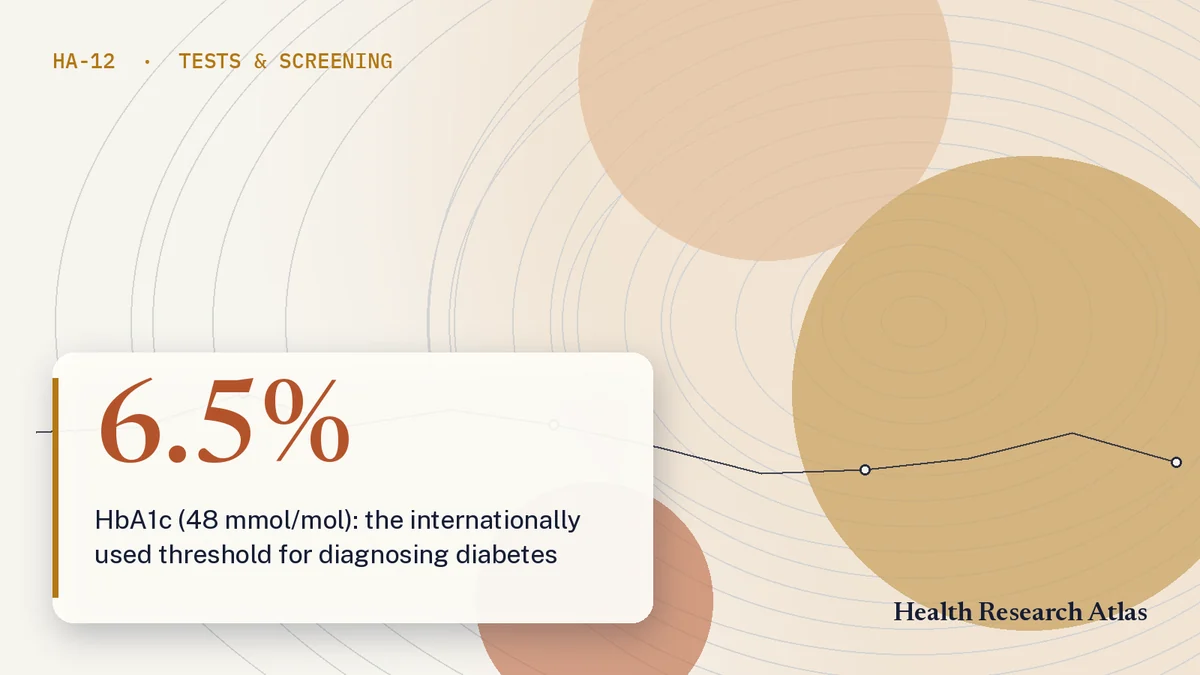
For more explainers on routine blood tests, including what an HbA1c result means, see our Tests & Screening section.
When to see a doctor
If your MCHC is flagged, discuss it with the clinician who ordered the test, especially if other results are also outside the range. Mention any symptoms of anaemia. The NHS lists tiredness and lack of energy, shortness of breath, noticeable heartbeats (palpitations), paler than usual skin and headaches.
Get urgent medical help if you haveChest pain, severe shortness of breath, fainting, black or bloody stools, vomiting blood, or very heavy bleeding. In an emergency call 911 (US), 999 (UK) or 000 (Australia).
It is also worth telling your doctor about heavy periods, pregnancy, a family history of thalassaemia, sickle cell disease or spherocytosis, or past gallstones or jaundice, which can be linked to hereditary spherocytosis. If thalassaemia runs in your family, the NHS notes you can ask your GP surgery for a blood test to check whether you're a carrier.
How strong is the evidence?
We grade this article moderate. How MCHC is calculated, its typical range and its main causes are long established and consistent across NIH sources, StatPearls, NHS laboratories and peer-reviewed laboratory reviews. Weaker points: reference ranges differ between labs and countries, our Australian example comes from a 2019 laboratory manual, and figures such as how often hereditary spherocytosis occurs are estimates that vary between populations (see our glossary entry on prevalence).
What we still don't know
There is no single agreed reference range or flag limit for MCHC, so the same sample can be "normal" in one lab and "high" in another. Most of what is known comes from laboratory reviews and reference texts rather than large studies of how well a mildly abnormal result predicts disease. For now, MCHC is best treated as one supporting clue inside the full blood count.
Frequently asked questions
What does it mean if your MCHC blood test is low?
A low MCHC means your red cells contain less haemoglobin than expected for their size (hypochromia). The most common cause is iron deficiency; thalassaemia is another. Less often it reflects copper or vitamin B6 deficiency, lead poisoning or a surge of young red cells.
What does a high MCHC blood test mean?
Most often it is a false result caused by the sample, such as cold agglutinins (red cells clumping), very fatty blood or burst red cells. A genuine high MCHC can be a sign of hereditary spherocytosis or another red cell disorder.
What is the normal range for MCHC?
MedlinePlus gives 32 to 36 g/dL, which is 320 to 360 g/L. UK and Australian labs report in g/L, and their ranges vary, for example 310 to 350 g/L at one NHS lab and 320 to 365 g/L at another.
Can you have iron deficiency with a normal MCHC?
Yes. MCHC measured by analysers is often normal in iron deficiency. UK guidance says MCH is a more reliable marker, and iron deficiency is confirmed with a ferritin test.
Do I need to fast for an MCHC blood test?
No. MCHC is part of a routine full blood count and needs no special preparation.
Sources
- MedlinePlus, US National Library of Medicine. Red Blood Cell (RBC) Indices. Last updated 7 October 2024. medlineplus.gov/lab-tests/red-blood-cell-rbc-indices
- MedlinePlus Medical Encyclopedia, US National Library of Medicine. RBC indices. Reviewed 27 February 2026. medlineplus.gov/ency/article/003648.htm
- El Brihi J, Pathak S. Normal and Abnormal Complete Blood Count With Differential. StatPearls. Treasure Island (FL): StatPearls Publishing; updated 8 June 2024. NCBI Bookshelf NBK604207
- Sarma PR. Red Cell Indices. In: Walker HK, Hall WD, Hurst JW, eds. Clinical Methods: The History, Physical, and Laboratory Examinations. 3rd ed. Boston: Butterworths; 1990. Chapter 152. NCBI Bookshelf NBK260
- Gulati G, Uppal G, Gong J. Unreliable automated complete blood count results: causes, recognition, and resolution. Ann Lab Med. 2022;42(5):515-530. doi:10.3343/alm.2022.42.5.515 (PubMed 35470271)
- Ciepiela O. Old and new insights into the diagnosis of hereditary spherocytosis. Ann Transl Med. 2018;6(17):339. doi:10.21037/atm.2018.07.35 (PubMed 30306078)
- Snook J, Bhala N, Beales ILP, et al. British Society of Gastroenterology guidelines for the management of iron deficiency anaemia in adults. Gut. 2021;70(11):2030-2051. doi:10.1136/gutjnl-2021-325210 (PubMed 34497146)
- North Bristol NHS Trust, Severn Pathology. MCHC: test information. Accessed 24 November 2026. nbt.nhs.uk/severn-pathology
- Manchester University NHS Foundation Trust, Division of Laboratory Medicine. Haematology User Guide: blood counts reference ranges. Issued 11 July 2024. mft.nhs.uk
- NSW Health Pathology. Reference Ranges Adult. February 2019. seslhd.health.nsw.gov.au
- NHS. Thalassaemia. Last reviewed 17 October 2022. nhs.uk/conditions/thalassaemia
- NHS. Iron deficiency anaemia. Last reviewed 26 January 2024. nhs.uk/conditions/iron-deficiency-anaemia
- Healthdirect Australia. Anaemia. Last reviewed November 2024. healthdirect.gov.au/anaemia
This article is for general information and isn't a substitute for advice from your doctor or another qualified health professional. See our medical disclaimer and editorial standards. Spotted an error? Tell us.